Key dates
Prizes
Up to (5) awards will be conferred. This includes one (1) certificate for one school/programme located within each of the 5 UIA Regions. The jury reserves the right not to award all the prizes if the entries fall short of the required standards. Announcement of an additional list of finalist commended entries for their distinctive qualities and merits is at the discretion of the jury.
Theme and objectives
Open to colleges, schools, departments, or programmes of architecture worldwide, the third edition of the UIA Award for Innovation in Architectural Education will recognise excellence in architectural and urban design education, focusing on innovative pedagogies that foster contributions to realising the United Nations Sustainable Development Goals across the five UIA regions, while reflecting their broad diversity. Aligning with the UNESCO-UIA Charter for Architectural Education (updated July 2023), the Award emphasises the role of architecture education in addressing the societal and environmental challenges facing the built environment, and in articulating the opportunities those challenges create.
This edition recognises the multitude of factors influencing the development of sustainable environments, which include focus areas ranging from climate action to health; from inclusivity and migration to community development; and from resource efficiency to heritage conservation.
Key criteria
Architectural education in the 21st century demands creativity and innovation; research and investigation; collaboration and civic engagement; environmental awareness and technical competence. Submissions for this edition of the award must therefore demonstrate:
- Excellence in Pedagogical Practice based on evidence of pedagogical innovation and enhanced learning outcomes;
- Excellence in Addressing Sustainable Development Goals based on evidence of innovation in content and teaching delivery, identifying challenges, and development of solutions.
In demonstrating excellence, entries should consider evidencing and documenting how the pedagogical programme addresses and delivers across the following areas:
- Innovative Pedagogy: by adopting and implementing pedagogical approaches that respond to current global debates in areas that may include health, heritage, digital tools, collaboration, trans disciplinarity, specific user group (children, youth, elderly), community and civic engagement, or a combination of one or more such areas.
- Impactful Inquiry: by demonstrating students’ inquisitiveness in ways that inspire a commitment to addressing social and environmental challenges.
- Inclusive Learning: by discerning and effectively enhancing the diversity of student learning needs, thus offering multiple learning opportunities.
- Research-Driven Design Education: by integrating findings from architectural research, scholarship, and professional practice in ways that add value to the learning environment.
- Interdisciplinary Engagement: by engaging with and potentially contributing to the established body of knowledge through working effectively across disciplines.
- Contextual Responsiveness: by articulating strategic and operational priorities of the context or region in which the school/programme operates.
Eligibility
The Award addresses university-level professional education in architecture which could be any recognized study programme for professional architectural education This includes university-level independent schools/programmes or schools/programmes within public or private universities.
- The school/programme must have been established for at least ten years.
- The school/programme must offer a professional degree in architecture, which is recognized by its local higher education authorities and/or local validation/accreditation body.
UNESCO-UIA validation is not a requirement for entry.
The Award Management Team (award manager and technical committee) will examine the submissions considering eligibility criteria before presenting them for review and assessment by the International Jury Panel. Entries not meeting the eligibility criteria will be disqualified.
Jury Members
- Jana Revedin, Advisor, UIA Architectural Education Commission (Germany) – UIA Representative
- James B. Brown (Sweden)
- Karine Dupre (USA)
- Lindy Osborne Burton (Australia)
- Jolanda Morkel (South Africa)
The Chair of the jury will be elected in the first panel meeting.
Alternate Juror:
Andrii Markovskyi, Member, UIA Architectural Education Commission (Ukraine) – R2 (UIA Representative)
Management Team (non-voting)
Ashraf M. Salama, Co-director, UIA Architectural Education Commission (United Kingdom/Egypt) – Award manager and Curator
Technical Committee members
- Selma Harrington, Co-director, UIA Architectural Education Commission (Ireland)
- Kevin Bingham (South Africa)
- Kaname Yanagisawa (Japan)
Results
Awarded Entries
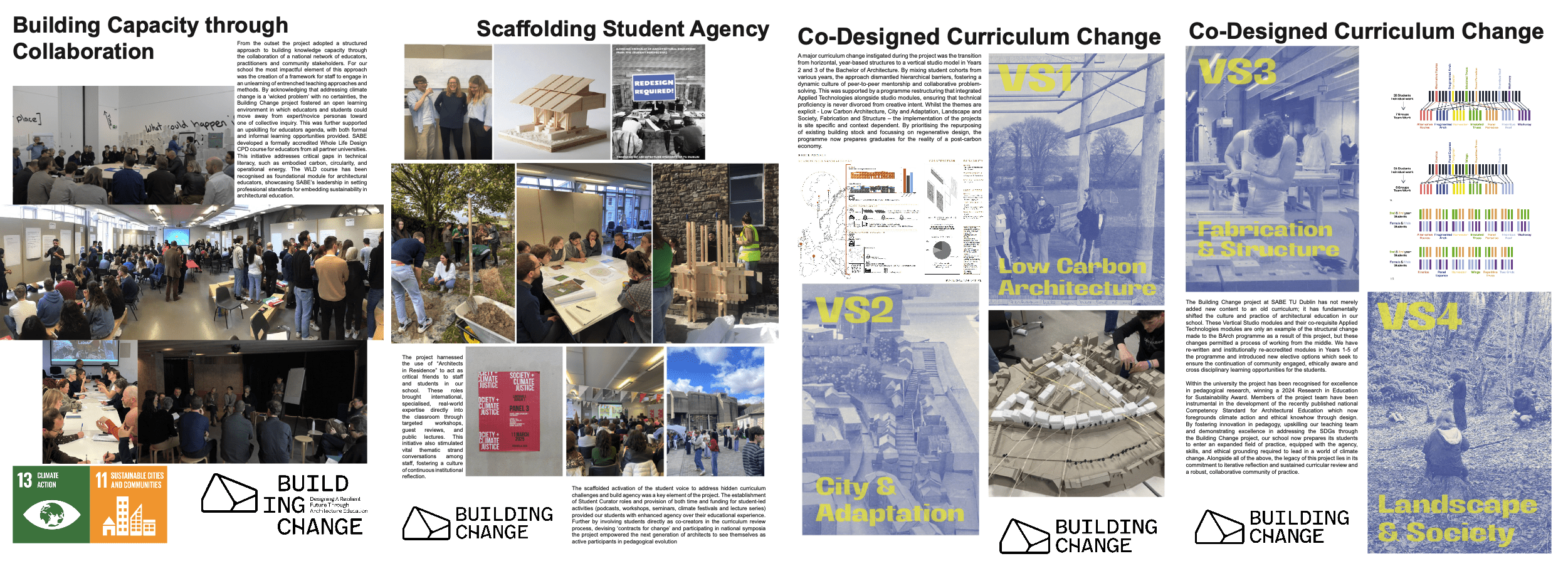
Technological University Dublin (TU Dublin), Ireland
Building Change — Bachelor of Architecture (Hons) Curriculum Reform
The jury awarded this entry for a nationally significant curriculum reform initiative that operates at a scale and policy reach that distinguishes it from most other entries in this cycle. Funded by the Irish Higher Education Authority and led by TU Dublin as national project lead, the Building Change project coordinated the transformation of architectural education across all six Irish schools of architecture, exemplifying a systemic, government-backed programme well beyond a single studio or institutional reform. Within TU Dublin, key innovations include a vertical studio model mixing year cohorts, an Architects in Residence programme, student-devised contracts for change, and a staff unlearning framework that treats climate change as a problem
with no expert solution.
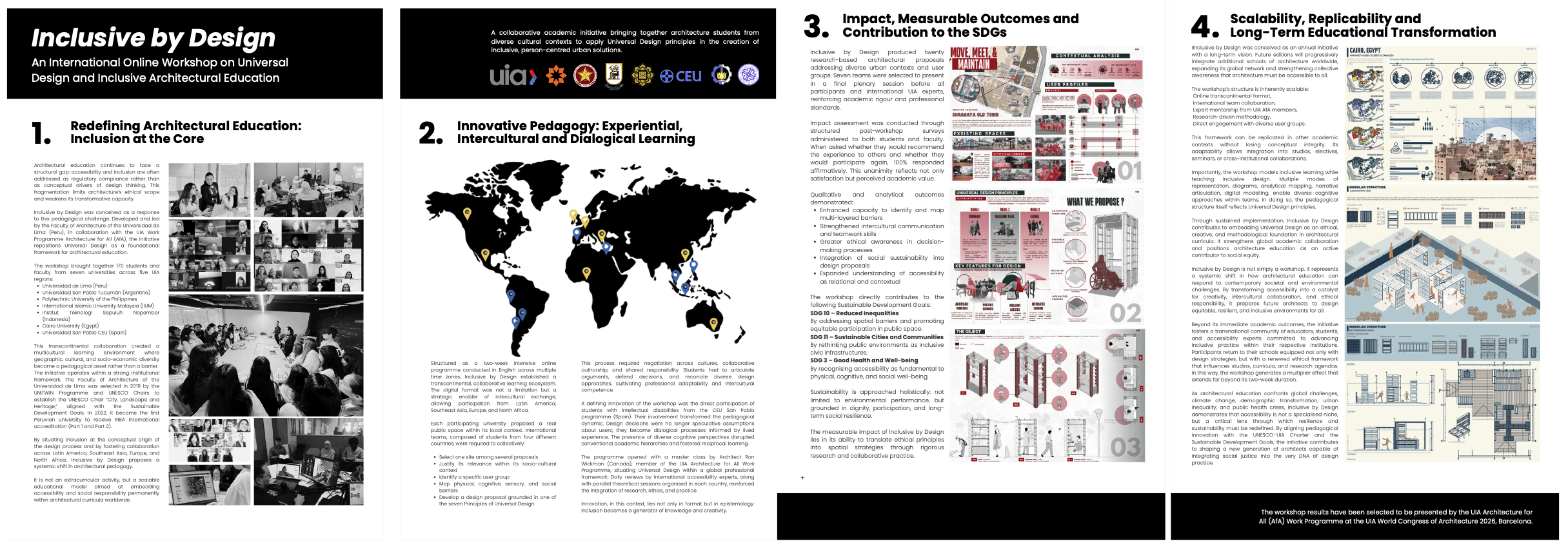
Faculty of Architecture, University of Lima, Peru
Inclusive by Design: International Online Workshop on Universal Design and Inclusive Architectural Education
The jury awarded this entry unanimously for a focused and well-argued contribution to one of the most underdeveloped areas of architectural education: the direct engagement of people with impairments as co-participants in the design process, rather than as subjects of speculative accessibility projects. The two-week international online workshop brought together 170 students and faculty from seven universities across five UIA regions. Its defining feature was the direct participation of students with intellectual disabilities from CEU San Pablo, Spain, shifting design thinking from projection to dialogue and repositioning Universal Design as an epistemological driver rather than a compliance requirement.
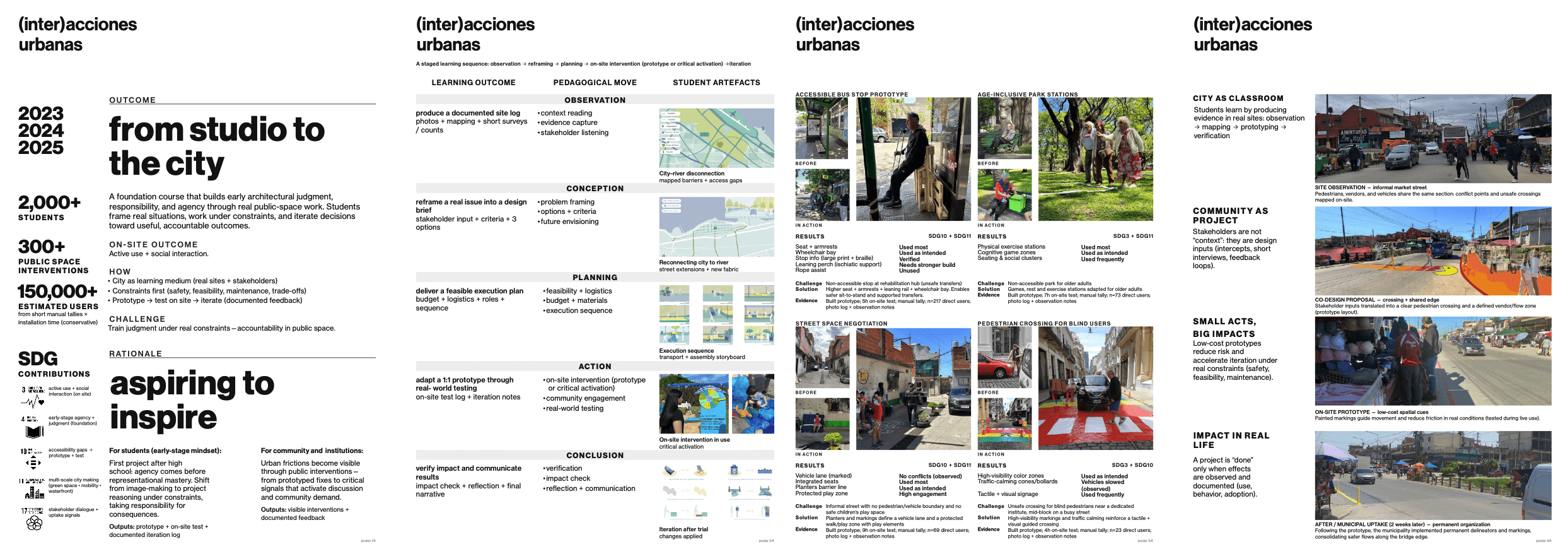
CBC, FADU, University of Buenos Aires (UBA), Argentina
(inter)acciones urbanas [Urban (Inter)Actions] – Cátedra Najmias, Taller de Proyectos – Introduction to Design Knowledge II
The jury awarded this entry for a structurally original and operationally convincing pedagogical model that converts a compulsory first-year foundational course, serving 400 to 600 students per term at one of Latin America’s largest public universities, into a city-scale design laboratory. Since 2023, more than 2,000 students have executed over 300 real public-space interventions across Buenos Aires, reaching an estimated 150,000 users. The programme’s defining contribution is its insistence that a project is complete only when real effects are observed and documented, not when it is represented.
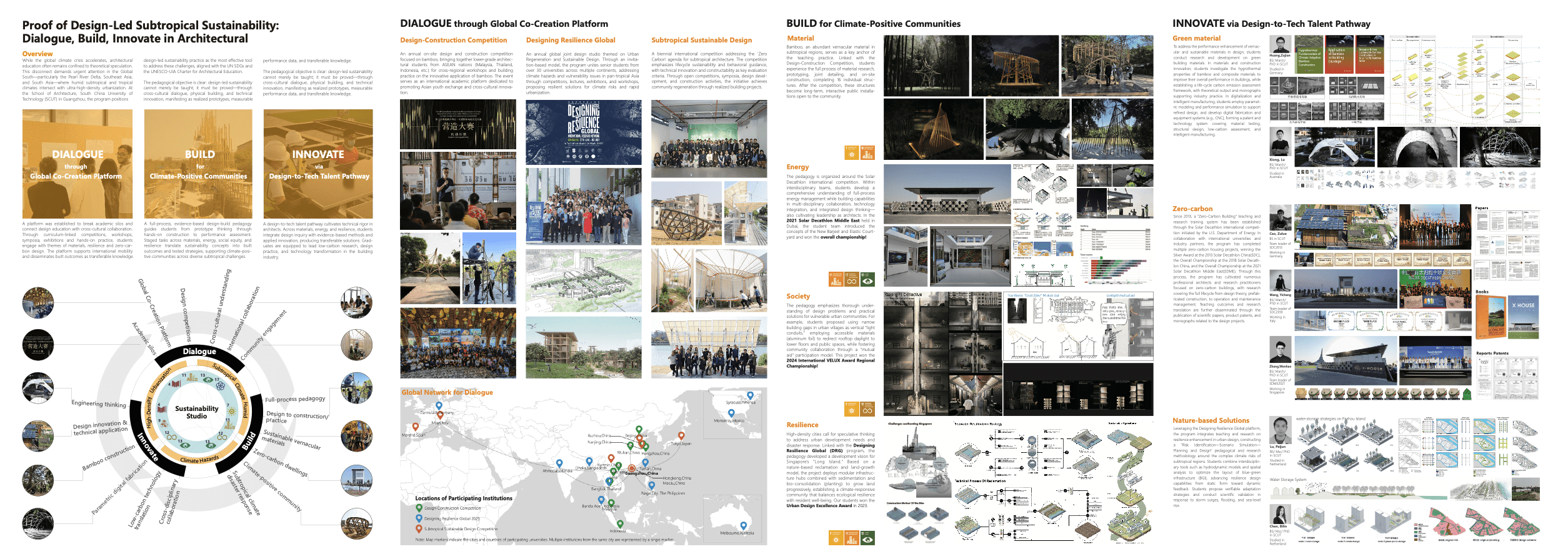
South China University of Technology (SCUT), China
Proof of Design-Led Subtropical Sustainability: Dialogue, Build, Innovate
The jury awarded this entry for a technically rigorous and institutionally embedded approach to sustainability pedagogy, grounded in the humid subtropical conditions of the Pearl River Delta. The Dialogue–Build–Innovate framework structures learning as a continuous cycle: global co-creation identifies climate and social challenges; construction validates sustainable concepts through physical making; and an innovation pathway translates design research into documented technology outcomes.
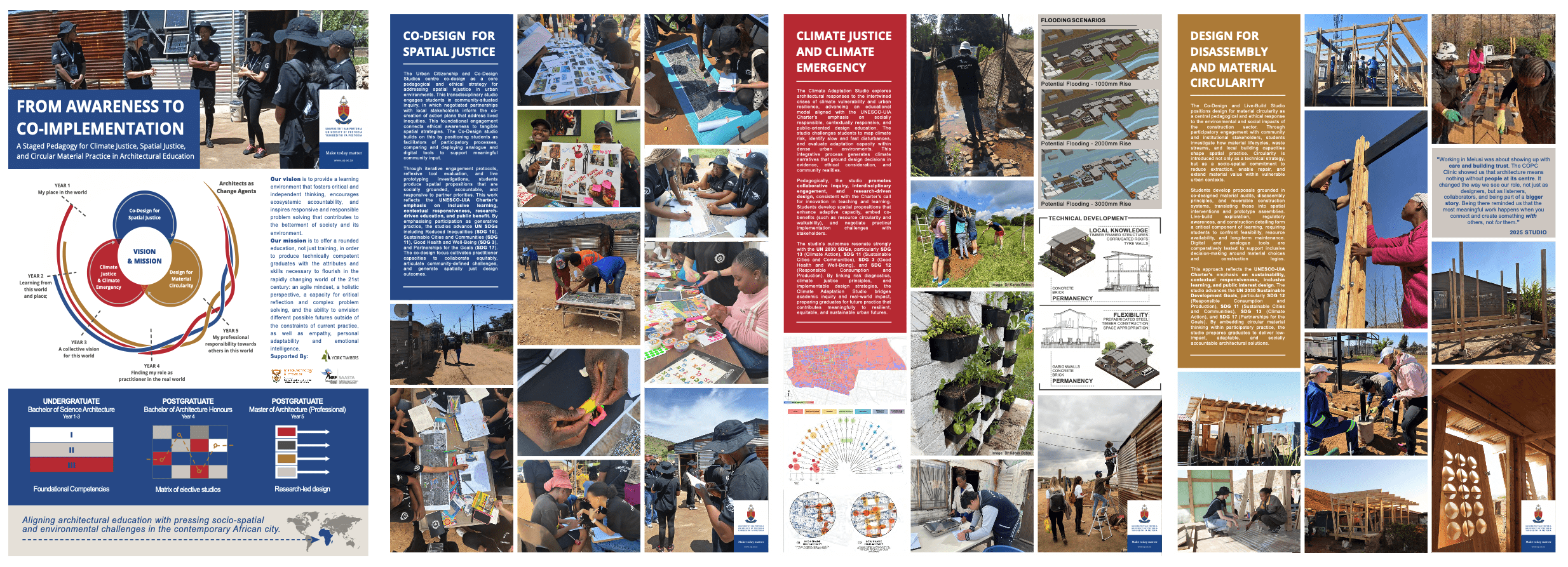
University of Pretoria, South Africa
From Awareness to Co-Implementation: A Staged Pedagogy for Climate Justice, Spatial Justice, and Circular Material Practice
The jury awarded this entry for a theoretically grounded and institutionally sustained model of full-curriculum transformation. The five-stage developmental trajectory — awareness, philanthropy, activism, solidarity, and collaboration — functions as a deliberate curriculum architecture, progressively expanding students’ ethical, methodological, and professional capacities across both the BArchHons and MArch programmes. Three thematic lines — climate justice, co-design for spatial justice, and design for material circularity — are woven throughout the curriculum rather than assigned to individual years, producing cumulative learning and long term community partnerships.
Commended Entries
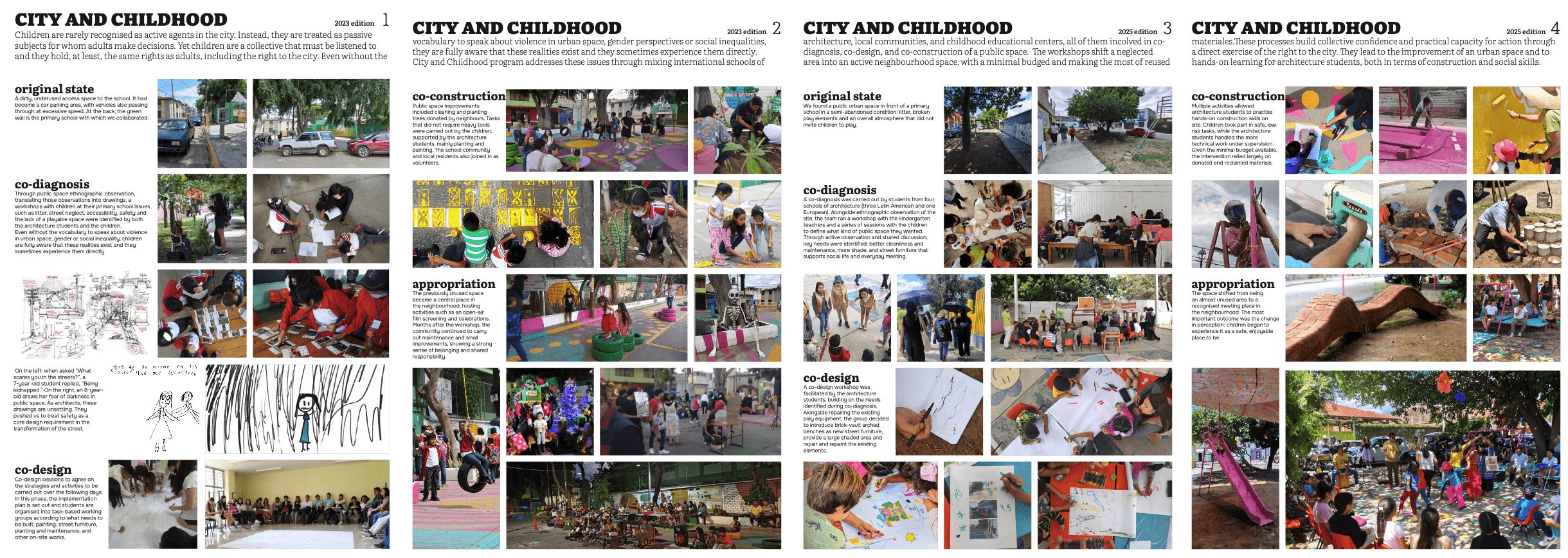
Polytechnic University of Catalonia (UPC), Spain
Arquitectes de Capçalera: City and Childhood International Workshops
The jury commended this entry for its child-centred approach to inclusive participatory practice, running since 2010 and documented here across 2023 and 2025 workshop editions delivered in Oaxaca, Mexico.
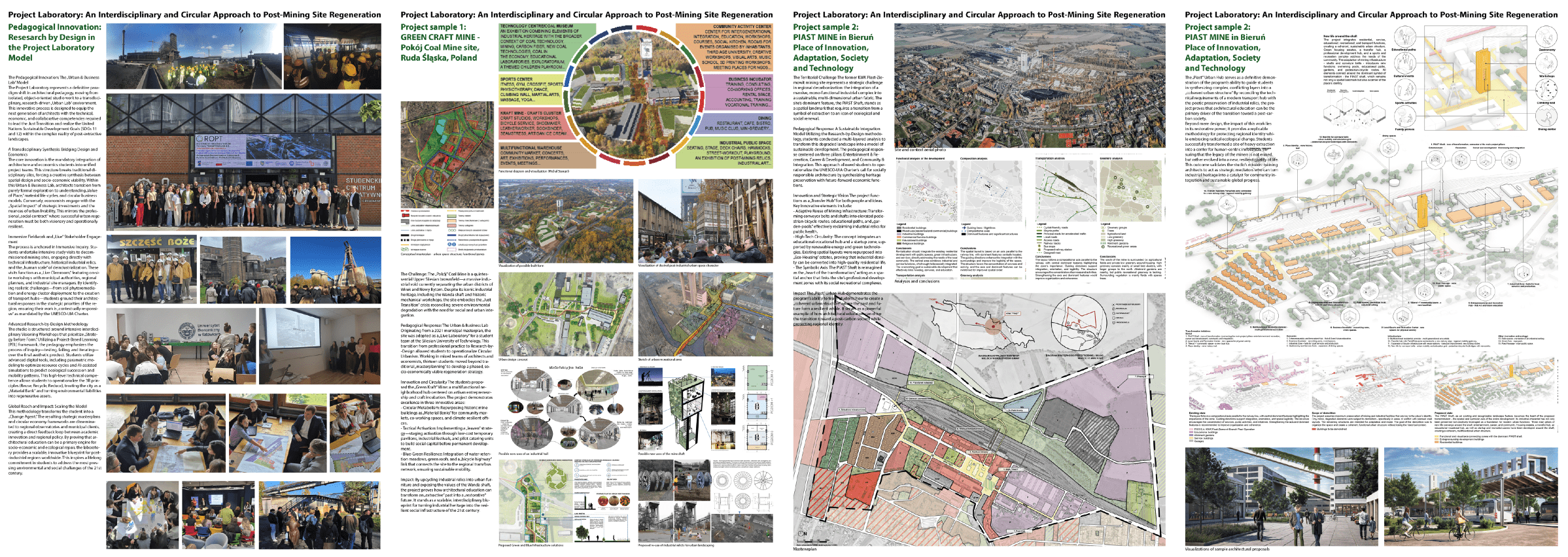
Silesian University of Technology, Poland
Project Laboratory: An Interdisciplinary and Circular Approach to Post-Mining Site Regeneration
The jury commended this entry for a rigorous and deeply contextualised approach to post industrial design education in one of Europe’s most pressing territorial transformation contexts: Upper Silesia’s decommissioned coal-mining region, navigating the social, environmental, and economic pressures of the European Just Transition.
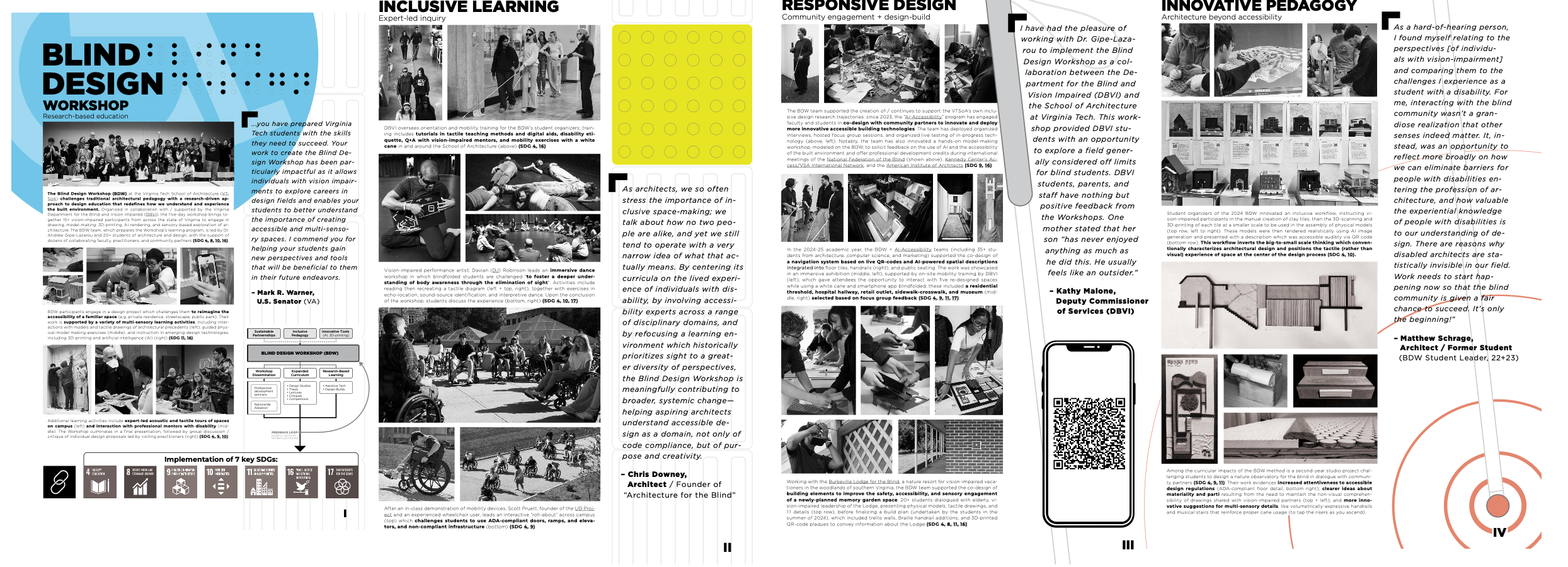
Virginia Tech, United States of America
Blind Design Workshop: Advancing Curricular Transformation with Collaborative and Inclusive Pedagogy
The jury commended this entry for a sustained, strengths-focused pedagogical initiative that positions vision-impaired participants as co-designers, critics, and knowledge-holders whose expertise is treated as indispensable to the profession.
Arizona State University, United States of America; and An-Najah National University, Palestinian Territories
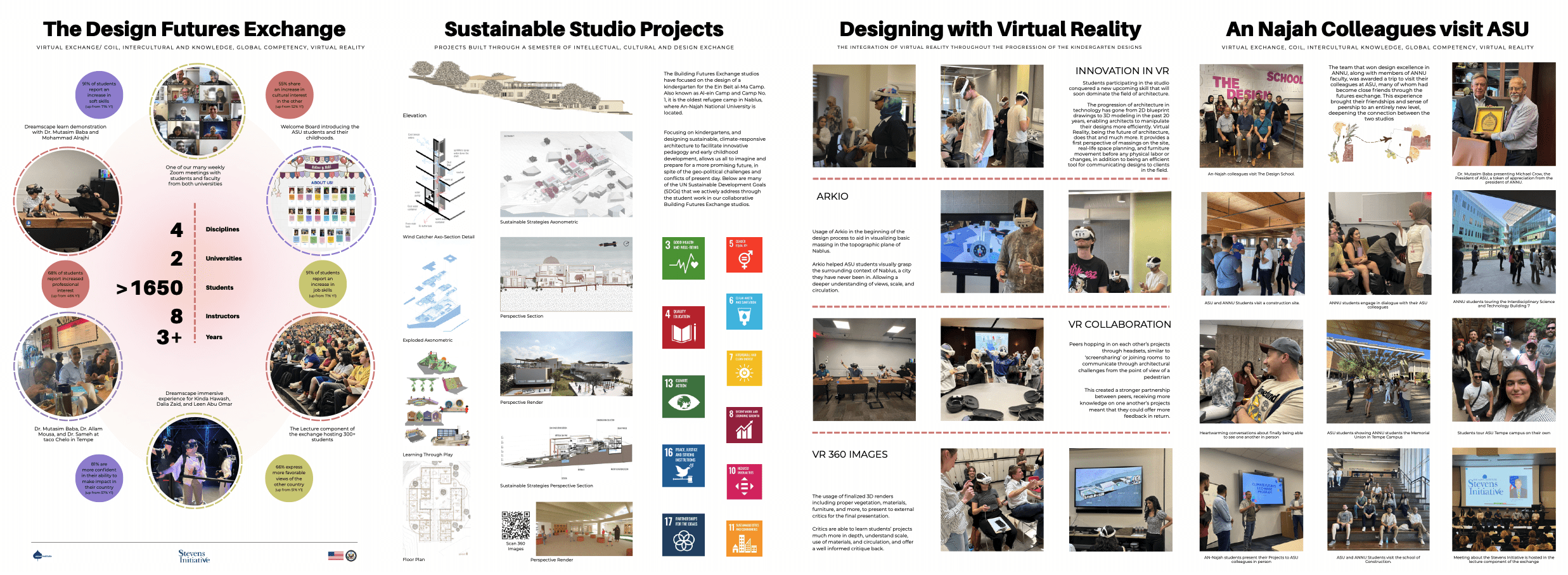
Building Futures Exchange