Josenia Hervás y Heras, Professor at the Alcalá University (Spain)
Introduction
There are places which, merely by being named, evoke lived realities, even if one has never been there. This is what happens to me with the Bauhaus. When I walk through its buildings, one hundred years after its female students once passed through them, I feel like one of them.
Perhaps it is because of its singular history, perhaps because they are our predecessors. What is curious is that, from the moment the Nazis closed the Bauhaus until the end of the twentieth century, there was hardly any interest shown in this important group of enthusiastic and hard-working women. However, so many years without news of them has only increased their appeal. Like when the cap is removed from a bottle of sparkling water, thousands of hidden stories have burst forth, and the bubbling has not yet ceased.
Weimar
When the Bauhaus opened in 1919, more women than men enrolled and, for that reason, it was decided that “only women of extraordinary talent” would be allowed to enter the school. A Bauhaus dominated by women, or feminised, was a nightmare for the Council of Masters, even though the number of men (79) and women (84) was very similar.
In the calculations for the first budgets, a projection of 100 men and 50 women was assumed (two-thirds male students to one-third female), and it was even proposed that women should pay a higher tuition fee than men (180 marks compared with 150). In the end, everyone paid the same tuition; however, since women continued to show great interest in joining the school, they were initially directed to the weaving workshop; a women’s workshop functioning as a separate compartment.
In reality, while many of these students made that workshop their own and carried out outstanding work, others managed to overcome that confinement. Even from within the weaving workshop they expanded their practice, because who can forbid one from developing their spatial vision? Who can deny one the drawing of a plan?
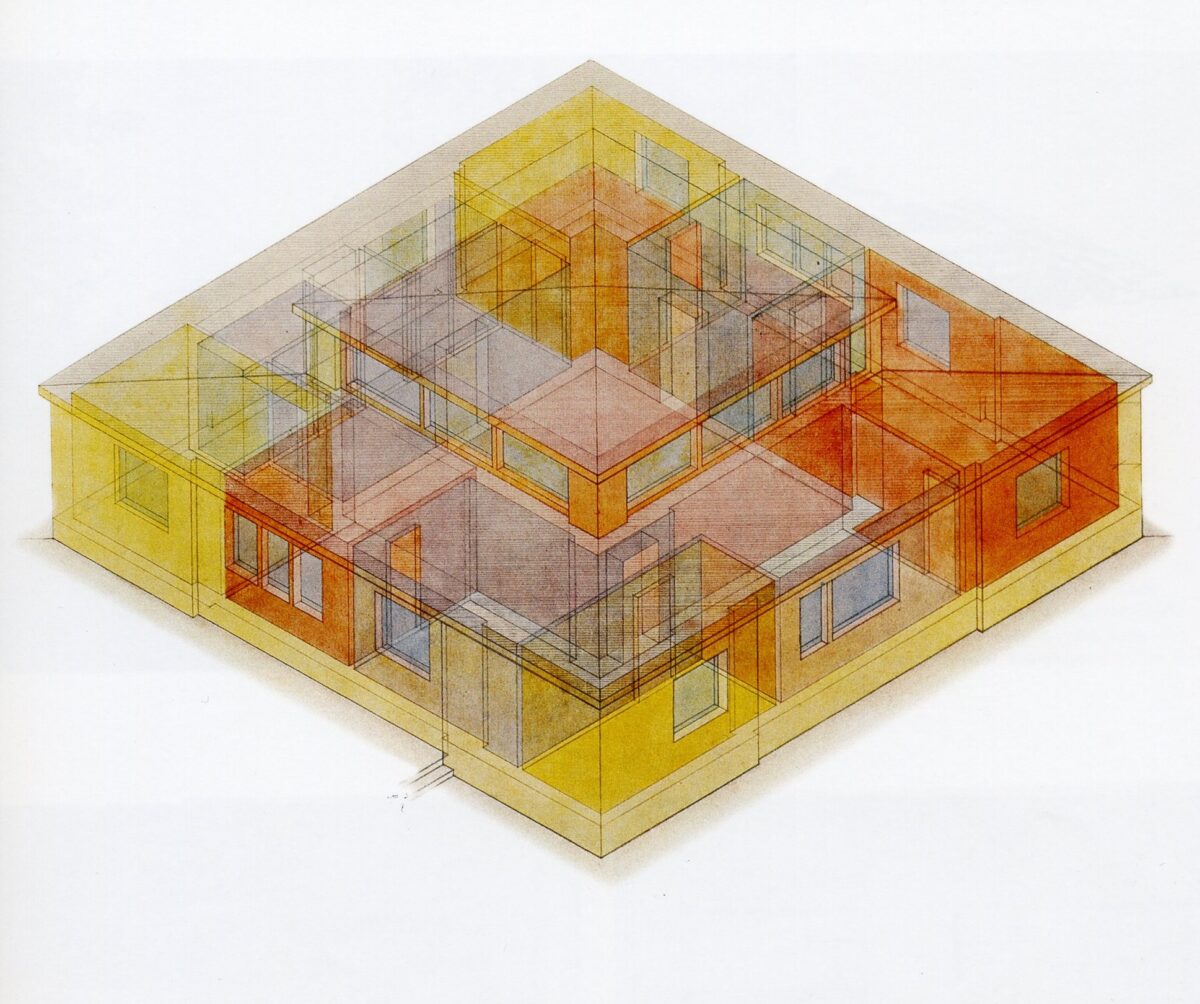
At the Bauhaus exhibition of 1923, the extraordinary talent required of these students was clearly demonstrated, and in the exhibition catalogue one could admire the isometric drawing by weaving student Benita Otte: a layered perspective representing the experimental house Haus am Horn, officially designed by the painter and master of the weaving workshop Georg Muche. A master who proudly declared that he had never handled a single thread throughout his teaching career.
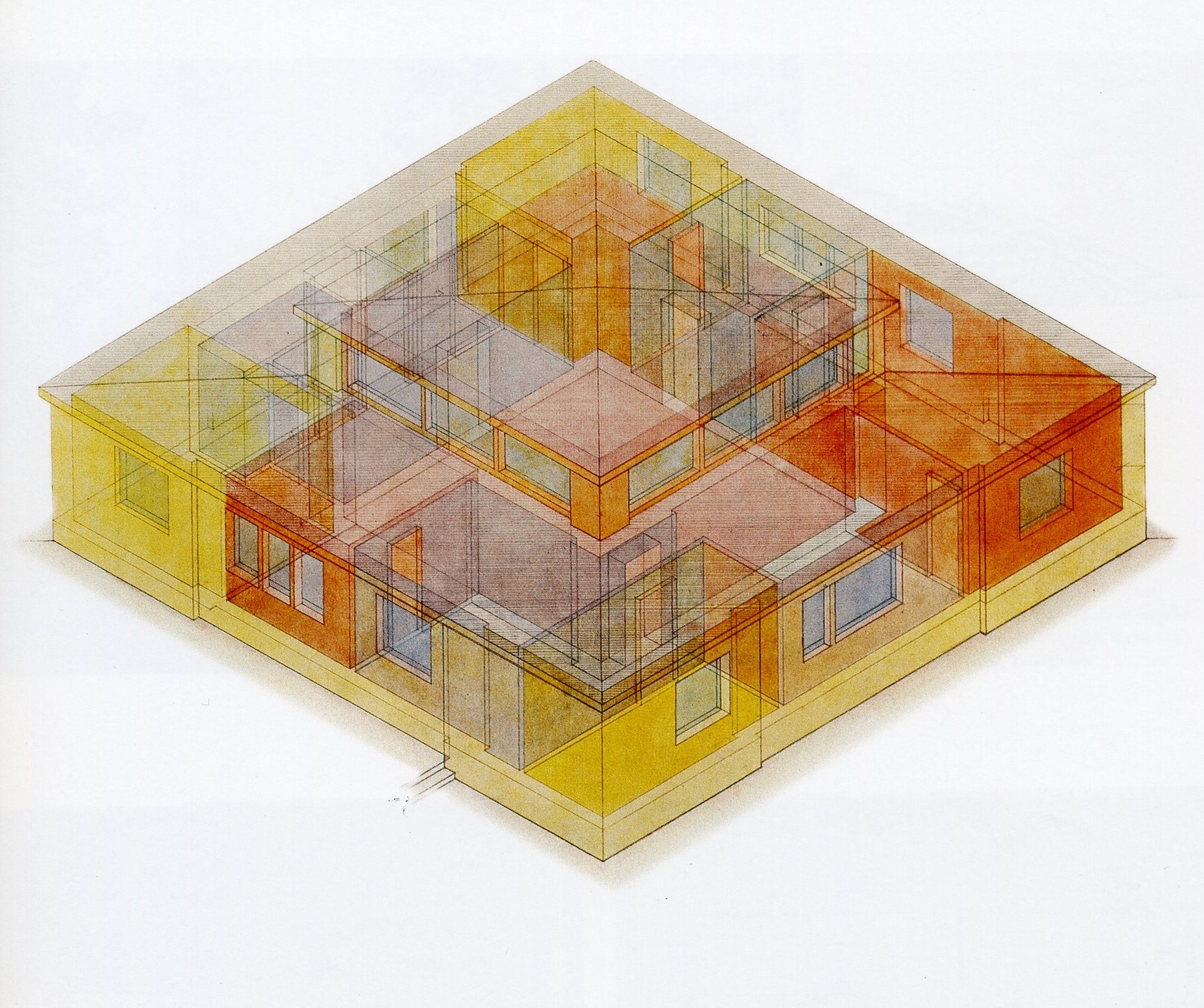
Fig. 1
Benita Otte: “Single-family house for the Bauhaus State Exhibition 1923. Design by G. Muche, Drawing by B. Otte.”
Source: Image included in the catalogue Staatliches Bauhaus in Weimar 1919–1923, pp. 165–166.
Today it is easy to compare the works produced in 1922 by the student Friedl Dicker and her colleague Franz Singer with houses similar to that of Georg Muche: flat roof, top lighting, and a plan without corridors. Both students left the Bauhaus in 1923 and would go on to have brilliant professional futures, tragically cut short in the case of Friedl Dicker, who was murdered in Auschwitz.
Dessau
The Bauhaus was forced to leave the city of Weimar and was established in Dessau from 1925 onwards. In December 1926 the buildings of its new headquarters were inaugurated, which would become an icon of twentieth-century architecture.
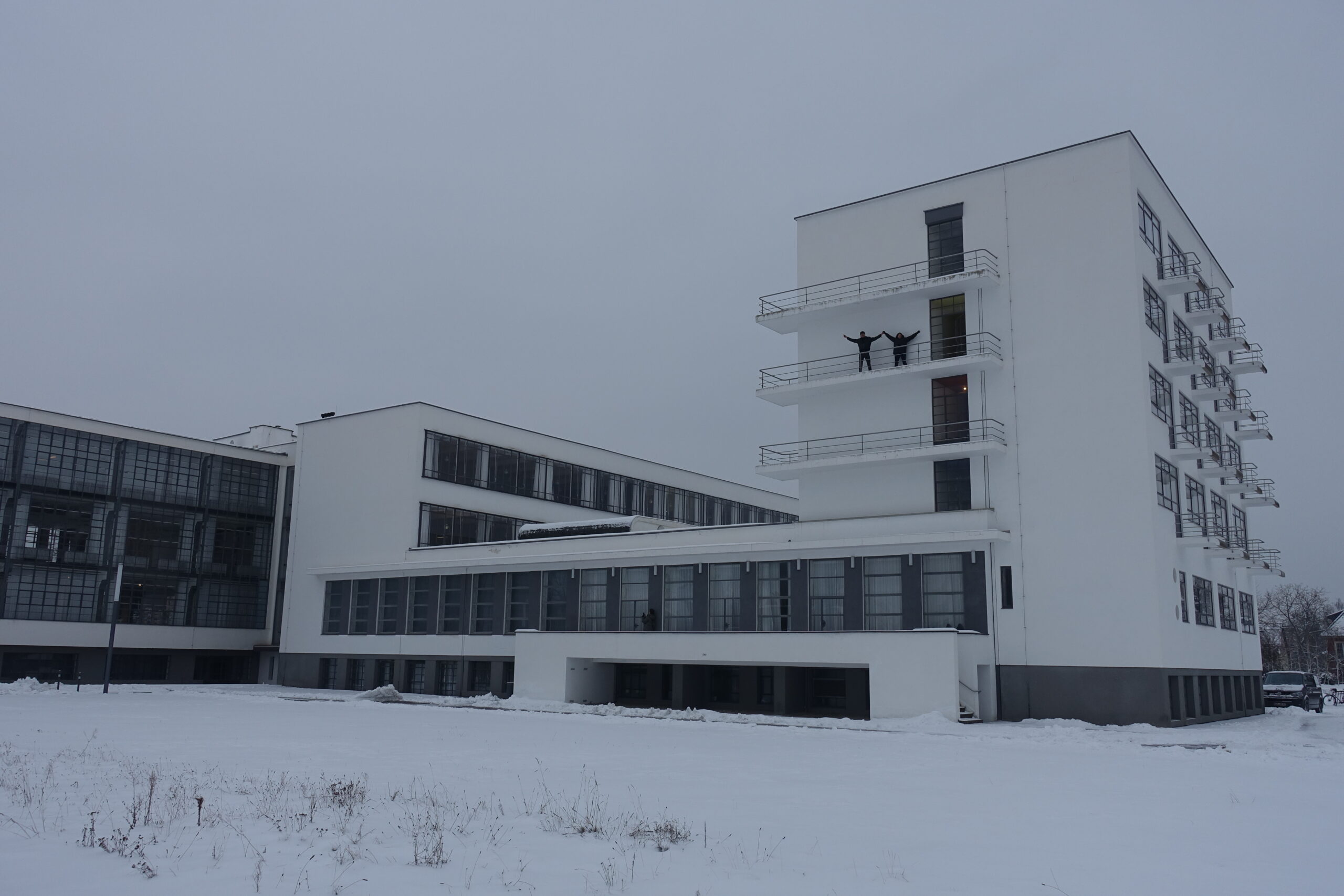
Fig. 2
The author and Esteban Herrero Cantalapiedra at the Bauhaus in Dessau, 2026.
Source: Photograph by Federico Herrero-Hervás, 2026.
This new phase would be highly productive, and we can see how the female students, who had previously been consumers of everyday objects, became producers of them: textiles, lamps, household utensils, furniture, toys and wallpapers. It was at the Bauhaus in Dessau that they were trained as textile engineers, industrial engineers and architects.
These predecessors of all of us — the women architects — have been the least studied group in the history of the Bauhaus. Even the master Lilly Reich, despite declaring herself an architect, is still often considered an interior designer. Her contemporaries themselves, even while recognising her as an architect, claimed that her work was carried out anonymously and would therefore not be remembered, because who asks, in an exhibition, whom they should thank for the pleasure of experiencing transformed spaces?
Most of the female students who attended the architecture classes (bau) did not complete their studies or were not granted a diploma; however, those who did succeed went on to build and even to establish their own practices, such as Wera Meyer-Waldeck. She became a great disseminator of the Bauhaus spirit through her numerous writings, lectures, exhibitions and works.
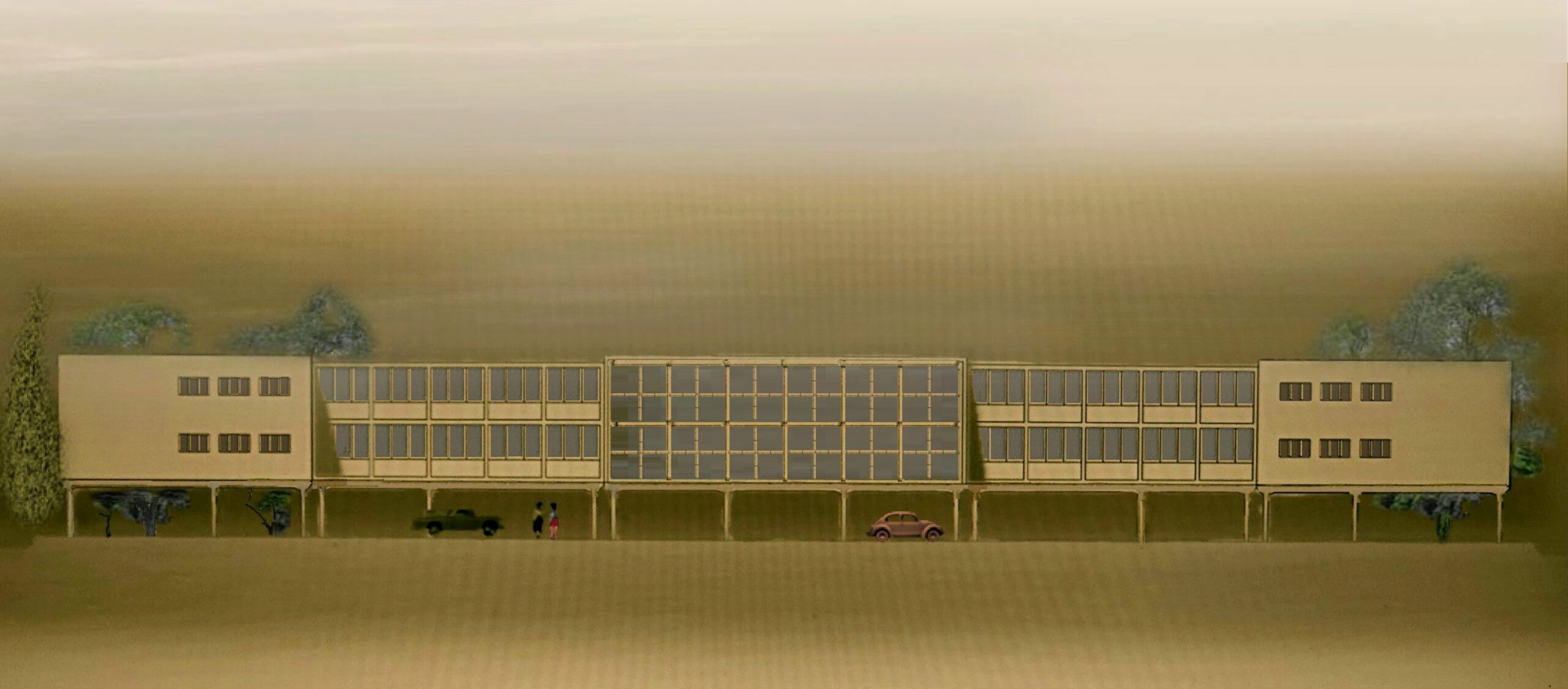
Fig. 3
Elevation of the female university residence in Bad Godesberg (Bonn), designed by the architect Wera Meyer-Waldeck in 1962.
Source: Drawing by Esteban Herrero Cantalapiedra and Josenia Hervás y Heras, produced from the original published in the local press at the time.
Berlin
As the school gradually diminished in size, its name grew ever larger. From a state school in Weimar it became a regional school in Dessau, and finally ended up as a private academy in a former telephone factory on the outskirts of Berlin. Yet its fame continued to increase as the authorities increasingly threatened its existence.
Some female students, already working as professionals, such as Annemarie Wilke, continued to carry out work at the school and helped their colleagues complete their projects, even though they had already obtained their architecture degrees.
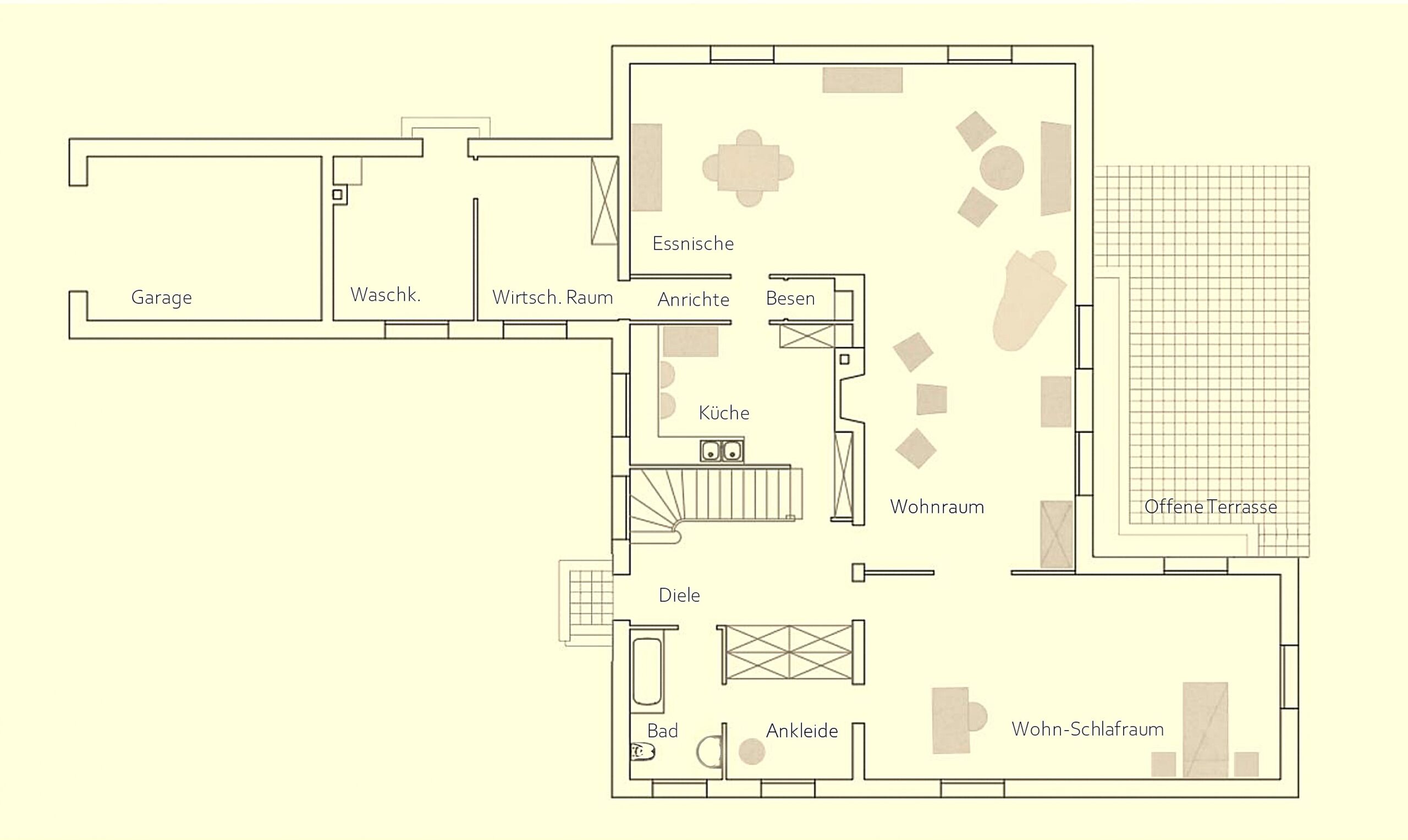
Fig. 4
Floor plan of a house for Frau Schulze in Klausdorf am Mellensee, project by the architect Annemarie Wilke, 1938.
Source: Drawing by Esteban Herrero Cantalapiedra and Josenia Hervás y Heras, produced from Wilke ‘s original project deposited in the Bauhaus Archiv Berlin.
The school was both a place of refuge and a vibrant environment. Approximately 1,400 people formed part of the Bauhaus community. This mixed youth who arrived there — some in a more informal way, others more committed to their studies — were the ones who gave life to the Bauhaus during its fourteen years of existence. Its final closure was an expression of the repression that prevailed for years in Germany and in many other places.
Conclusions
Architecture was always present at the Bauhaus; it was its driving force and its raison d’être. Architecture united with the other arts and crafts in complete harmony, just as the men and women who were trained there were united. Without women, the Bauhaus would have been born mutilated.
The school’s three directors were architects, and many of its students — both men and women, with or without diplomas — were also architects who collaborated in solidarity to make this institution an international reference for schools of architecture.
To celebrate the fiftieth anniversary of the Bauhaus, an exhibition was organised that travelled through several countries. It began in Stuttgart in 1968 and ended in Tokyo in 1971. During those years it had stopped in London, Paris, Toronto, Pasadena and Buenos Aires. Spanish appears, together with English and the original German, in the three versions of the catalogue.
In the final pages of those publications, a brief biography was included of the most notable people who had taken part in the teachings of the Bauhaus. In the original German catalogue, out of 99 people considered worthy of remembrance, only 11 were women, and none of the qualified women architects or students from the architecture workshop were mentioned. In the English version of 1969, 108 people appear, of whom 12 are women: Friedl Dicker is added. In the Spanish version of 1970, one more person was included: Benita Otte, bringing the total to 109.
I climb the stairs of the Bauhaus in Dessau once again and feel as though I pass all these women, tirelessly going up and down, just as T. Lux Feininger photographed them and Oskar Schlemmer drew them.
As I walk through the building, now celebrating its hundredth anniversary, I think of all of them, and especially of my predecessors, the women architects. This time they are not forgotten. In this centenary we hold them very much in mind.
Bibliography
1 MULLER, ULRIKE, Bauhaus women. Art. Handicraft. Design (Paris: Flammarion, 2009),84.
2 WINGLER, HANS M., Das Bauhaus. Weimar, Dessau; Berlin 1919-1933 (Köln: Dumont, 2002. First edition 1962), 34. Copy of the budget estimated by Gropius in February 1919.
3 DEARSTYNE, HOWARD, Inside the Bauhaus (New York: Rizzoli, 1986), 124.
4 HÖVELMANN, KATHARINA; NIERHAUS, ANDREAS; SCHROM GEORG, Atelier Bauhaus, Wien. Friedl Dicker und Franz Singer, (Wien: Wien Museum/Müry Salzmann, 2022), 137-139.
5 OTTO, ELIZABETH & RÖSSLER, PATRICK, Bauhaus women: A global perspective (London: Herbert Press, 2019).
6 HILDEBRANDT, HANS, Die Frau als Künstlerin (Berlin: Rudolf Mosse, 1928), 151-152.
7 HERVAS Y HERAS, JOSENIA, (2024), 20-29. https://iuu.uva.es/publicaciones/dossier-ciudades/mujer-espacio-domestico-retratos-desigualdad-genero/
8 HERVAS Y HERAS, JOSENIA, Las mujeres de la Bauhaus, de lo bidimensional al espacio total (Buenos Aires: Diseño, 2015), 346-371.